Have we been using AI the wrong way? Data Experience and AI in processes


Think of a common task: a product is missing its net weight. Whoever spots it rarely knows where the value should go. It turns into a ticket, an email to the right person, a wait for a reply and finally someone who navigates to the right place in the right system. The change itself takes ten seconds. Everything around it can take days. Sometimes weeks.
Over the past few years, almost every organisation has adopted AI in one way or another. Yet the example above often looks the same as it did five years ago. That says something important about where we have applied AI so far. And where the real value lies.
Where we are today: AI in the wrong place?
Most of our work is not the work itself. According to Asana’s Anatomy of Work Global Index (a study of almost 10,000 people), 58 percent of the working day goes to work about work: coordinating, searching for information, asking around and following up.
We see the same pattern. Most of the time in a typical process today is spent explaining what needs to be done, passing it on, waiting for answers and looking for the right system, view and field. The execution itself is often the smallest part.
And execution is exactly where most organisations have put AI. We let it write product copy, classify items, draft emails and write code. That is valuable, but it streamlines the smallest part of the job. We believe it can be turned around: let AI handle things like communication and navigation, so that we humans can spend our time on what actually creates value. That is where the big productivity gain is.
At the same time, we have often let AI go too far in the other direction: we ask it for strategic advice and let it formulate decisions. This is where we think we have used AI the wrong way. AI is at its best when it helps us make well-informed decisions. Not when it makes them for us.
Silos and power users: the hidden tax
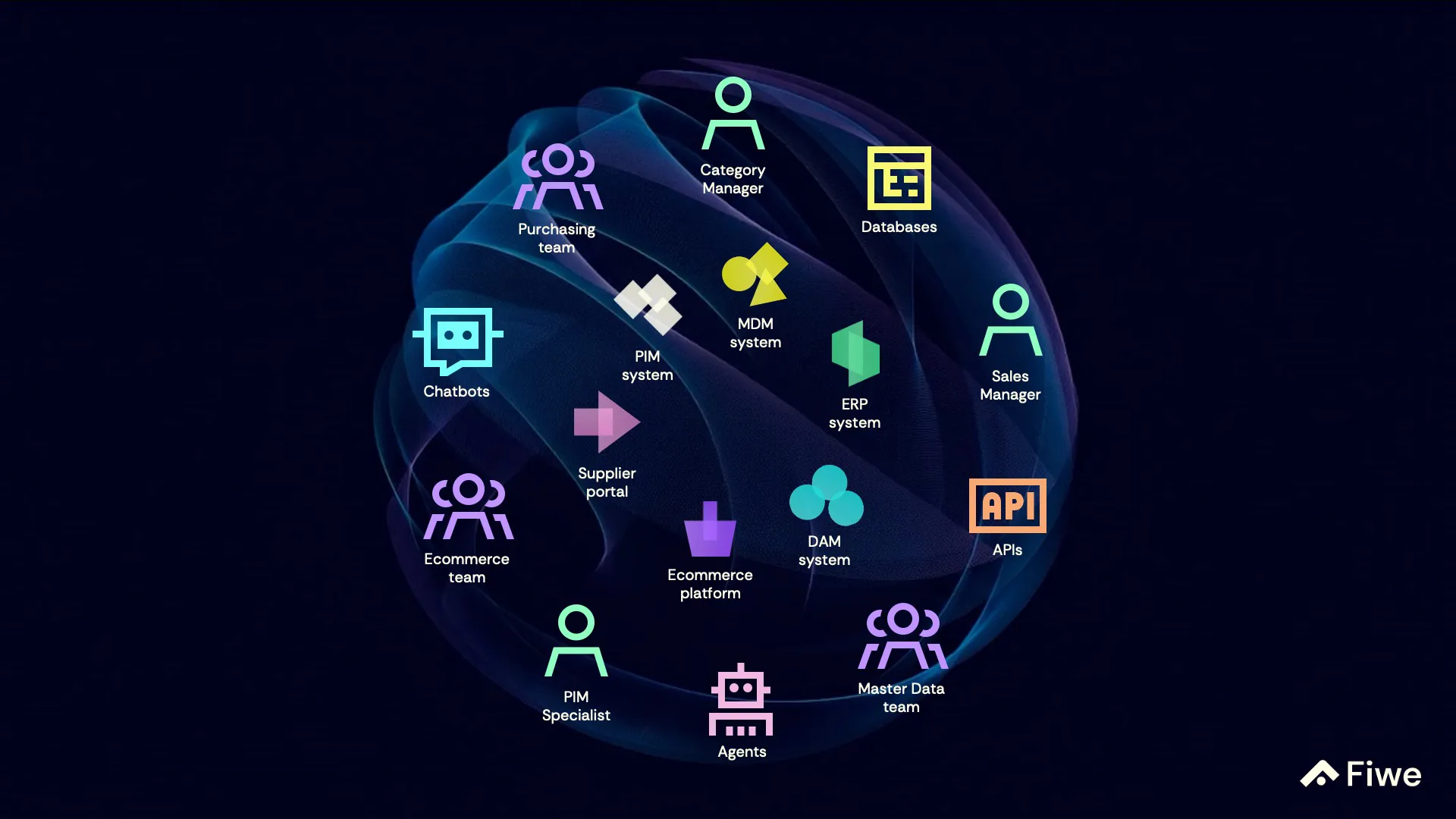
In most larger organisations, data lives in stable and well-structured systems: ERP, PIM, MDM, e-commerce and supplier portals. That is good, but each system has its own interface and its own language, and only a few people truly know them.
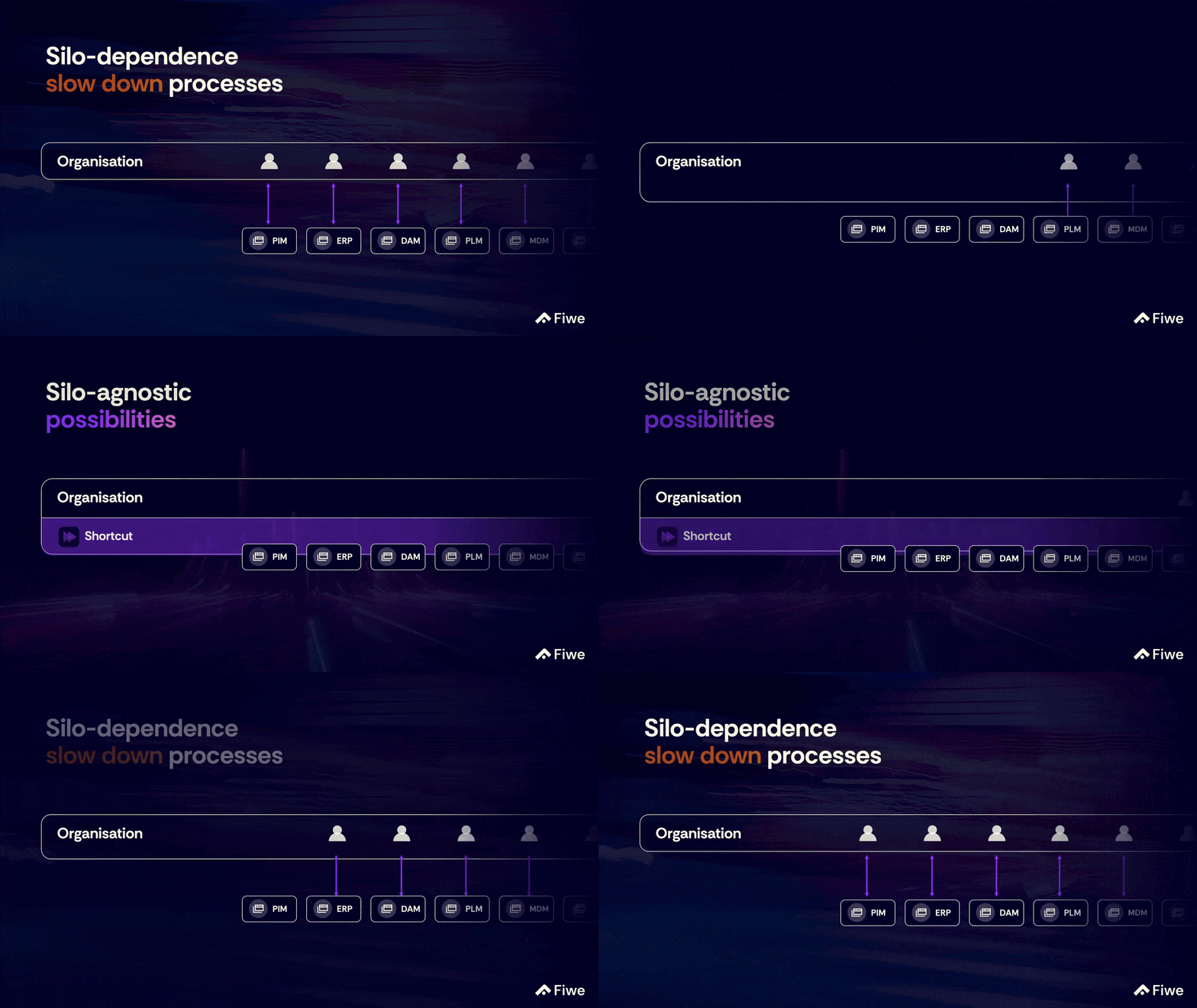
The result is a dependency on power users. Anyone who sells, buys or runs a business area has to go through someone who knows where to find things. We call this a silo tax and a navigation tax: costs that do not show up in any budget, but that slow down the whole organisation at a time when everything is moving faster.
In our podcast episode Utbenat: Datasilos, Sebastian Mildgrim points out that silos are rarely about the technology itself, but about departments having different needs: “Our different needs create different dialects of data”. Each part of the business optimises its own world, often at the expense of the whole. The solution is not to tear down the walls between systems and departments, but to build communication between them.
Where we are heading: from searching to doing
Data Management is about the “back end”: getting data structured, correct and in the right place. That work is more important than ever. But for data to create value, the “front end” also has to work. This is what we call Data Experience: how people actually find, understand, use and trust data in their daily work.
In a well-functioning Data Experience, users do not need to know which system the information lives in. They describe what needs to be done and the rest takes care of itself.
An example on a national scale
Let us take a concrete example. At the end of September 2026, the US government launched America.gov, a single entry point to federal agencies. Instead of navigating thousands of websites, citizens ask their question in a chat that pulls the answer from around 29,000 official sources.
But the interesting part is the next step. From early 2027, citizens will be able to apply for, register for and track cases directly in the same interface. From asking to doing, without even needing to know which agency owns the question. That is exactly the shift waiting inside our organisations.
The building blocks that make the shift possible
Several technology trends are making the shift possible right now.
The first is MCP (Model Context Protocol): an open standard for connecting AI to existing systems, often called “USB-C for AI”. Instead of a custom integration for every system, the system itself tells the AI what data is available and what can be done. Take a PIM system as an example: there, an AI can find the product missing its net weight, see that the field is empty and suggest the change. When several systems speak the same language towards AI, a single task can draw on all of them at once.
The second is generative interfaces: instead of users searching for the right screen, an interface is created for the specific task at hand. This is already a reality. In October 2026, OpenAI began rolling out GPT-6 with Intelligent UI in ChatGPT, where answers are built from text, graphics, buttons, forms and charts tailored to the question, for more than 1.2 billion weekly users. The idea is that software should adapt to people, not the other way around. The same principle will move into organisations’ own systems: only the fields, facts and buttons that are needed, pulled from the systems where they belong.
The third is context and memory: an AI model is never better than what it knows about the situation, such as your concepts, your rules and your history. A lot is happening here right now, with techniques and methods for giving models the right context at the right moment and a memory that lasts over time, for individuals, departments and organisations alike. It is an area we work with a lot ourselves, as it makes AI both more efficient and considerably more capable. We have discussed this in podcast episodes such as Varför minns inte en AI som en människa? and Utbenat: Context, for anyone who wants to dig deeper.
The fourth is decision models: AI that does not write long answers, but chooses between a set of given options in a fraction of a second. OpenAI presented its Decisions API at the end of September 2026, and in October Cloudflare released its open Clef models in the same category, competing with, among others, Jev from TypeSafe. What they have in common is that the AI interprets a situation and suggests a clear next step, while people and the organisation’s rules keep the decision.
On top of this, more building blocks are maturing quickly: open standards that make it easier to connect AI to existing systems, and agents that can work directly in web interfaces. Individually, they are technical advances. Together, they point in the same direction.
The result: AI understands what needs to be done, gathers the right information and presents a simple interface where a person confirms and carries out the task.
What it looks like in practice: Shortcut
At Fiwe, we have recently been experimenting with something we call Shortcut, designed to do exactly this inside organisations. Shortcut is a smart layer between the user and the systems where the data lives.
Take the example of the missing net weight. Instead of a ticket, an email and a wait, the user describes the task. Shortcut understands what needs to be done, retrieves the right item and creates an interface with exactly the field that needs to be filled in. The user confirms and the change lands where it belongs. The same applies to everyday tasks such as:
- classifying a product in the right category
- replacing a product image
- translating a product description
- correcting the spelling of a name
Three things matter here:
- The systems stay. The data still lives in your secure and well-structured systems, and power users keep their interfaces.
- More people can do more. Whoever knows the product, the customer or the deal can make the change themselves, without being a system expert. It democratises both data and action.
- Silos are bridged, not torn down. Shortcut works across several systems at once, so the task drives the work, not the org chart.
There is a path, but you take it step by step
Everyone is talking about AI agents that work in the systems on their own. That is where things are heading. But trying to connect everything, teach AI everything and let go of control all at once is a big risk. We believe in a controlled path in three steps:
- Connect: Give AI access to the systems and data the task requires.
- Train: Let AI suggest and people confirm, so the solution learns how you work.
- Allow: Once you trust that it gets things right, AI can handle selected tasks on its own.
This way, trust grows alongside capability, and every step delivers value in itself.
The prerequisite: data AI can trust
There is a paradox here. The simpler the “front end” becomes, the higher the demands on the “back end”. Put simply, the demands on Data Management grow as Data Experience develops.
A person navigating a system can notice that something looks off and ask a colleague. An AI that has to interpret a task, gather information from several systems and suggest an action cannot. It needs data that is agent-ready:
- A single source of truth: It must be clear which system owns customer, product or supplier. Otherwise AI gets conflicting answers and picks one of them. This is the core of Master Data Management.
- Shared definitions: “Customer” or “product” can mean different things in different parts of the organisation. People resolve that with common sense. AI does not.
- Clear ownership and rules: Who can change what, and what requires approval? Without Data Governance, there is nothing for AI to follow.
- Information that holds up in context: It is not enough for fields to be filled in, they also have to be right. Read more in our post on data quality and information quality.
That is why Data Management and Data Experience belong together. One makes data reliable, the other makes it usable. Organisations that already have their master data and governance in order will be able to move towards agentic ways of working much faster than those that do not.
Getting started: four questions to ask now
- Where does the time go? Pick a common process and measure how much of it is communication, navigation and execution. The answer usually surprises.
- Where is the bottleneck? Are there power users everyone has to go through? That is often where the quickest win is.
- What data must AI be able to trust? Start with the concepts and master data the process relies on, not with everything.
- What feels like science fiction today? The task that seems impossible to simplify may already be possible. That is often where the greatest value lies.
AI has already changed how we write and search. The next change is about how we work together with data, across systems and departments. Organisations that start building the foundation now will gain a lead that is hard to catch up with.
Want to talk about AI and the future of how we interact with data? Don’t hesitate to get in touch!
Frequently asked questions about AI in business processes
Data Experience is about how people find, understand, use and trust data in their daily work. Data Management makes sure data is correct and structured. Data Experience makes sure it is usable, no matter which system it lives in.
It is an interface created for the task at hand, so the user does not have to find their way around a ready-made system. It shows only the fields and information needed, pulled from the systems where they belong.
It means the data is correct, consistent and well-defined enough for an AI to use it without human common sense. That requires a clear source of truth, shared definitions and clear ownership. In other words, good master data and Data Governance.
In most cases, no. We believe AI is most useful when it gathers information and suggests the next step, while people and the organisation’s rules keep the decision. Over time, once trust is in place, AI can handle selected tasks on its own.
Start with a process where a lot of time goes to searching, asking and waiting, and where a few people are bottlenecks. Map the data the process relies on and make sure it holds up before you let AI work with it.
A chatbot answers questions. An AI agent can also take action, such as updating a value in a system. Getting there requires both reliable data and clear rules for what the agent is allowed to do.