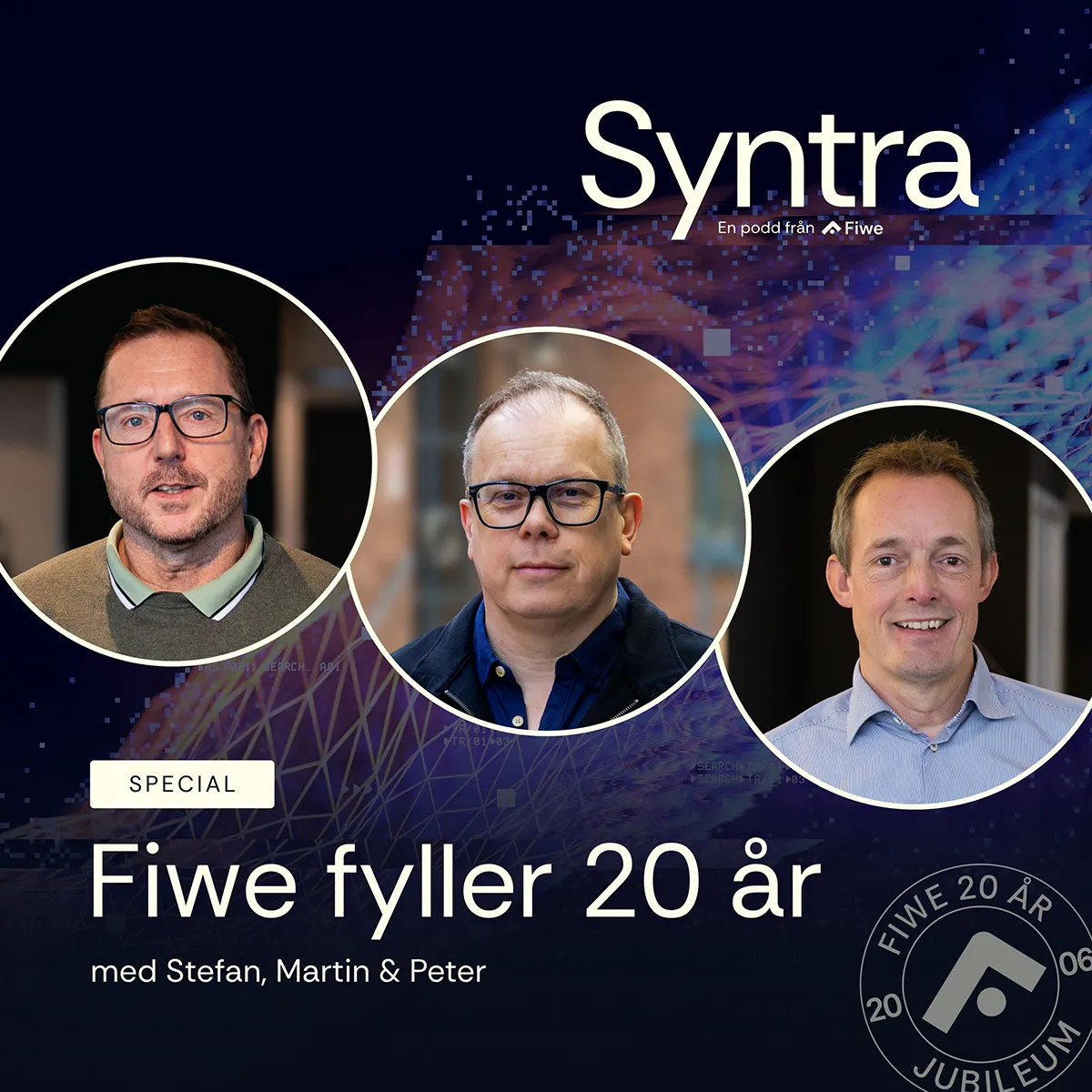
About the episode
Fiwe turns 20, and we're celebrating with a special episode of Syntra. Mitra Javadzadeh brings together Stefan Sjöblom, Peter Karlsson and Martin Skarin, three colleagues who have been here since the earliest years and who between them have seen almost the entire journey from the inside.
The conversation starts in 2006, when the MP3 player was the big piece of technology news and the choice between Java and Microsoft decided who even got to compete for a delivery. From there they walk through how e-commerce matured into an industry where large companies change platform every five or ten years, why PIM became the thing everyone is now asking for, and how procurement changed shape from five hundred rows in Excel to user stories and needs-led conversations.
They also get into how the work itself has changed: fewer physical meetings but considerably more customer contact, freer technology choices but higher stakes in choosing correctly, and customers who are more involved and a more important part of shaping the outcome than ever. Asked what was most enjoyable, then or now, they don't agree. Enjoy the episode!
In this episode, you’ll learn:
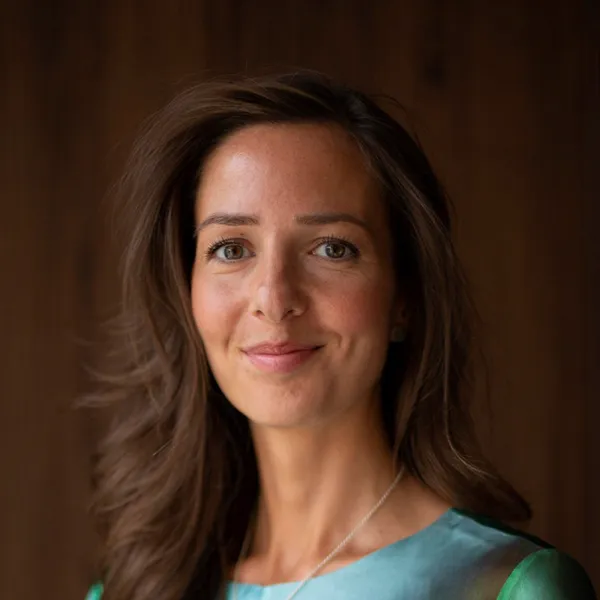
Voices in this episode
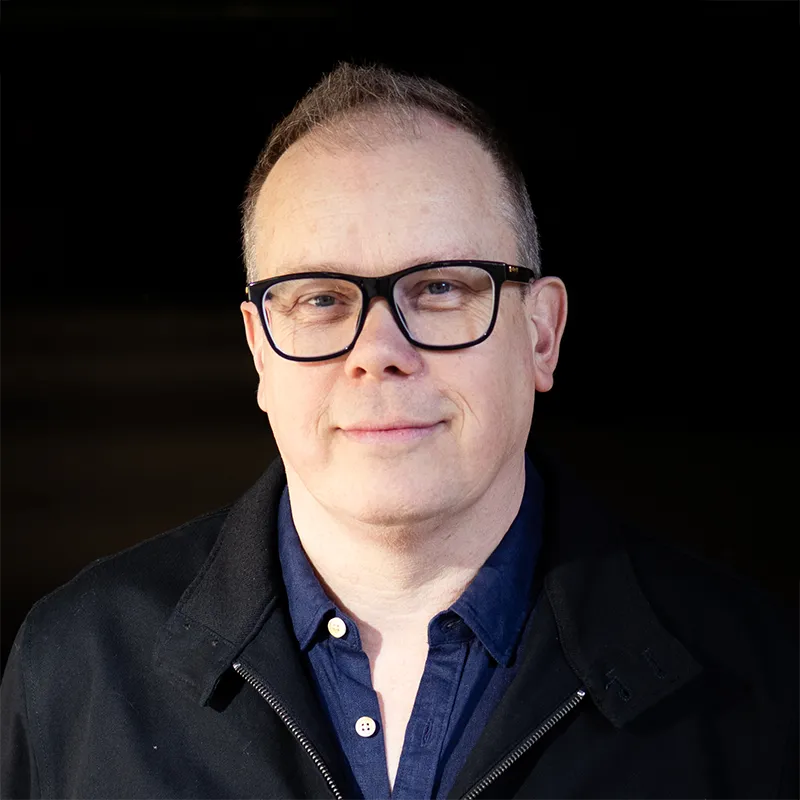
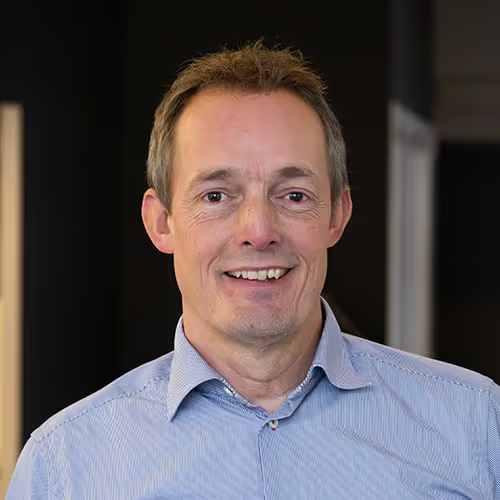
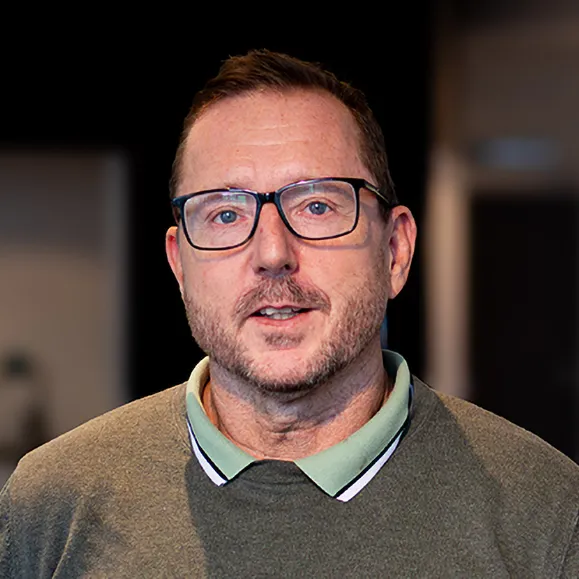
Listen to the episode
Transcript of the episode
Introduction
Mitra:
A warm welcome to our special episode, where we'll be talking about Fiwe, which celebrates twenty years today. And with me today I have Stefan. Hi. Who are you, Stefan, and what do you do at Fiwe?
Stefan:
As I said, I've worked here for twenty years, and I'm a project manager and Team Success Manager.
Mitra:
Wonderful! It'll be really exciting to hear your perspectives and reflections. If you can remember that far back.
Stefan:
Yes, exactly.
Mitra:
And we also have Peter with us. Hello, hello! Who are you, Peter?
Peter:
My name is Peter Karlsson, and I work at Fiwe with presale, or tech sales, trying to help customers and prospects understand their problems, challenges and needs, and turn that into something we can help with and land with them.
Mitra:
Exciting! It'll be great to hear about that too, what has happened over these twenty years. Quite a lot. And last but not least, Martin. A warm welcome! Who are you, Martin?
Martin:
I've also worked here for twenty years, and I'm a technologist, which basically means I focus on development and technologies. I have a long history in e-commerce, you could say by now.
What did the world look like twenty years ago?
Mitra:
There's a lot to talk about here. Twenty years, and so much has happened in just two. But if we try to rewind the tape and take the outside view, what did the world look like twenty years ago? A small question.
Martin:
A small question. I still remember it pretty well, because a big piece of technology news had just arrived, and that was the MP3 player. It was fantastic. But from there to today, an enormous amount has happened. You could say that when we started Fiwe, we went in with product information, e-commerce and content systems as our base, and that's still what we do. But the emphasis has shifted over the years, you could say.
Peter:
Who was responsible and who ran the procurements for different things has really evolved over these years. In the beginning there was maybe a bit of a hangover from the nineties, that division where you focused on particular technologies. You ran Java, or Microsoft was a big watershed. And of course that mattered for delivery too. Either you could be part of delivering, or you couldn't, depending on which technology stack you had focused on.
Stefan:
And looking at when we started, I'd say the market was a very hot market when it came to e-commerce. Now it has matured and platform changes happen less and less often. You notice the larger companies switch maybe every five years, and they get by with upgrades, and if they run a new version it might be ten. So it's a fairly mature market when it comes to e-commerce, I'd say. And PIM has higher demand right now. There are still large companies that don't have a PIM at all. They still have data scattered across different places, maybe even running some Excel file. So that demand is very hot in that market.
Mitra:
Why do you think demand for PIM has increased?
Stefan:
Well, quite simply because they don't have it. Every larger company has e-commerce, and it's higher data quality people are striving for, higher data quality, and they want faster time to market. You don't want data scattered across several places, which makes it really hard to maintain. So PIM is very much on the agenda now, I'd say.
Mitra:
So the increased data requirements have driven the need for a working PIM system?
Stefan:
Yes, exactly. Making the business more efficient and reducing administrative maintenance and that sort of thing too. Absolutely.
Peter:
And it's both the market, meaning the customers, who want more and better product data so they can make their choices more easily, but also so they can offer product data to their customer's customer. Where you might be gathering information for a building you're completing, so you can document every component in it, everything from safety data sheets to EPDs used for climate calculations. And then a whole set of legal requirements comes on top of that, which also builds a need to put product information into a structured system. You can no longer get by keeping it in an ERP system, or in Excel for that matter.
From manual steps to automated processes
Mitra:
Right. If we think about the pace of change over these twenty years. How much has changed in just the last five years compared to the fifteen before that? Has there been a shift in how fast things change?
Martin:
I think what's changed is how fast things can change now. If you look at the early years, it was more the era of the big platforms, with a lot of technical challenges, and the focus was maybe on technologies and mobile phones and e-commerce and building out the channels. But today it has become more about process improvements and a more mature industry, where you have many different technologies and looser couplings between both vendors and systems, which makes business life completely different. Because I mean, PIM has gone from being a necessary evil for e-commerce, so you could get hold of the images and texts you wanted to show externally, to becoming a business-critical part of your process. How you even get articles into your company and start selling them. Or selection, with your assortments and so on. So that's a big change.
Peter:
Yes, absolutely. And when we started, the discussion with customers landed with the IT department as the main recipient of that kind of message. Because management had told them that e-commerce is something we're going to get going with. Get something started. And that has shifted over to the people who actually need it to run their business. So it lands more with marketing and sales in that dialogue. And you go from having an understanding within IT that, yes, it's complex and technically difficult to build integrations that hold together over time, to an expectation that it should just work. I frankly don't care whether you build in Java or Microsoft, or whether you use this application or that platform. I have a function, I have a need. Solve it.
Mitra:
Do you see a difference, looking back twenty years, in communication between people compared to communicating through technology? Was there more human-to-human communication? It doesn't only have to be out towards the end customer, but also within companies, to work and get tasks done. What differences do you see there compared to today?
Peter:
I'd say there was a lot of... If you looked at a process, it was very rarely fully automated. There were always a number of manual steps that made the process stop and not continue until Anders had done his job. And then something happened, and we had a system solution, and then Lisa did her job, and the process could flow. Now there's a completely different need to automate processes, and that's regardless of whether we're talking about processes in e-commerce or in product information. If you can get good product data in from your supplier, why should you look at it at all? If all the quality checks you've set up show green, well then let it pass straight through, and instead you spend your time focusing on the exceptions, the ones that failed.
Fiwe's journey: a business idea that holds up
Mitra:
Mm. And if we then raise our gaze towards, or narrow it down perhaps, towards Fiwe over these twenty years. We've been talking from the outside view. How has Fiwe changed over these twenty years?
Stefan:
Well, I think the original business idea holds up pretty well today. We started with PIM and e-commerce as two domains. Since then we've obviously changed products. We've built adjacent products around these domains, but those are still the focus. When it comes to projects and that sort of thing, I think that before we sold more project-driven work. We got a budget for a project and ran it, and maybe we sold customizations. Now we also work more with a customer buying a team for a longer period of time. So that's something I think has changed a bit as well.
Mitra:
And for those who don't already know Fiwe, could you explain, Stefan, the original idea? What is the original idea?
Stefan:
I'd say e-commerce was above all what we focused on, that was the big area. Then we also had PIM. PIM was in our thinking too, even if it grew later. It came in a few years later, and now it maybe dominates more, I'd say. Then some adjacent services came in around that as well. And now we're perhaps moving more into MDM and those parts too. But those domains are still the focus, I'd say.
Martin:
I think our contact surface with customers has changed quite a lot, from having been much narrower towards certain individuals. People sat in isolated teams, with a handful of people responsible for e-commerce, and a handful responsible for product data and so on, to being much, much broader. Many, many more are involved around both systems today. So that has changed how we work as well, you could say. That we work in many more parts of a customer's organization, across their business areas.
And perhaps we help, by being small and being in so many places, to create a holistic view. Because I think many are still somewhat misorganized. That they look at things very much from a system-maintenance perspective and perhaps don't look at their processes as much as they should.
Peter:
No, absolutely. And to support that shift, we at Fiwe have also been on a journey, where we've gone from, as you mentioned Stefan, classic waterfall projects where we had a project manager and a business analyst who went out and interpreted the customer's requirements and came home with documentation that was then put in the hands of the developers. Now we're talking about DevOps teams, where the developers themselves take the dialogue with the customers. What is it that needs to be built and developed? And they often turn most of that dialogue around into: okay, what's the actual need? What's the problem we're trying to solve here? So we become a much better partner in that discussion.
Finding platforms that fit the Nordics
Mitra:
But what was Fiwe's focus twenty years ago? What did you focus on? How did you work?
Martin:
It was about finding products for our area. We saw our area, and e-commerce had its heyday up until 2010 or 2011, something like that.
Peter:
When a great many companies didn't have e-commerce at all.
Martin:
But PIM systems were born around 2004, 2005, 2006 and so on. We were explorers, looking for systems that fit Swedish export industry, you could say.
Mitra:
Right, so a greater focus on product and function and what a product could offer. What role did Fiwe play there, alongside these large, well-known platforms that you've worked with for a long time? What was the need? Was there a specific connection to Swedish support and being local?
Peter:
Yes, that was often the angle. We looked for the best possible platforms, which we then helped adapt to Swedish or Nordic needs and conditions. That meant we had, early on, a very good dialogue, or were forced to have a very good dialogue, with the platform vendors and their R&D. Because we wanted to push functionality into them and get them working in the right direction and developing things.
Mitra:
Mm. Twenty years ago, support here in the Nordics was thin on the ground. Was it hard to find resources that could support the market?
Stefan:
When it came to e-commerce we ran IBM. That's an American product, and eventually it became Indian. So we had... But we had very good sales in the Nordics, I think. Sales was good, but local support resources were harder, I'd say.
Martin:
I think our B2B focus was what shaped our journey a little. Because Sweden was very early on consumer retail and mail order and so on. But slower and more deliberate within B2B. So our background in ERP and manufacturing is something that came into play when things started to explode on the enterprise side.
The delivery model and customer contact
Mitra:
And how has Fiwe's delivery model changed? You've touched on it a bit here, with how communication happens in the teams. Martin, you mentioned earlier that you talk to more different kinds of people. Or as you said, Peter, that you maybe only talked to IT. How has that changed?
Peter:
A big part is that we talk to essentially everyone at our customer's company, and to the people who sit with the real problems. So we avoid the game of telephone, where someone summarizes problems and needs on the customer's side, which goes via the customer's project manager over to a project manager and business analyst on our side. Where we might then have built things that, in the best of worlds, match the actual need. But the way we work today, we have much greater opportunity to capture requirements and needs directly, because we're talking to the right people at the customer.
Stefan:
And I'd say one thing is that after covid we really moved into Teams meetings. We started using Teams meetings. So I'd say we have many more meetings with customers today. We usually run teams, and then we have standups, maybe two or three depending on team size, and then two or three times a week. Then we might have a status meeting. Then we have various... And if we run Scrum, that project method, we have different ceremonies with planning and review. So some weeks we easily have four meetings with the customer, and that's a difference. Before, you had these physical meetings. You travelled down for two days and talked to the customers, and then maybe you checked in via email or Jira. I think we have much more customer contact now. Even if we don't have physical contact, we have much more customer contact now, I'd say.
From I-shaped to T-shaped consultants
Mitra:
So communication has generally increased, you could say. And we've talked about how Fiwe had a product focus, a function focus. We have technology and data requirements that have driven the development of how we use systems and how they can support us. And we've talked about how communication has increased too. How does that affect customers and how you drive the company forward? How are all these different departments supposed to sync and collaborate? And how does that tie into how we work at Fiwe today? That was a big question.
Martin:
Yes, that was a big question.
Peter:
The way we talk about it internally, and often with customers too, is that you go from being an I-shaped consultant, with extreme depth in the small niche you've focused on and a perfect command of it, to becoming some form of T-shaped consultant instead. Where you become much broader in your area, and in what you're interested in and want to discuss with the customer. Because the customer is interested in looking at a problem and covering the whole process. If a customer comes to us with a detailed, super-niche problem, of course we'll solve it. But seen across the whole process, it isn't certain that's the best solution for the larger need.
And that's a change we see, that our consultants have been on a huge journey, which is great fun and developing.
The silos that remain at customers
Mitra:
Do you see that companies' own organizations have changed too? Or are they still stuck in... Let's say we need to talk to more different kinds of departments and suddenly also understand other systems, as well as processes and so on. Have customers' organizations changed, or are they the same?
Martin:
Not that much, I'd say. Communication has changed, in that it's easier to communicate with people via Teams and similar today. But I don't think anyone has reorganized yet. The question is whether and when that will come. I don't think it has happened yet.
Peter:
No, what we often see at customers is that it's fairly siloed. You have a master data department sitting in PIM updating product information, and then you have an e-commerce crew sitting in their own silo running that business. And then you have purchasing sitting with their responsibility, seeing that okay, it already starts with the purchasing agreements, making sure suppliers are given responsibility for submitting correct and accurate data. Seeing that whole flow, everyone does that of course. But breaking up these silos, so that a requirement that exists at the customer out in e-commerce carries all the way through the MDM department and out into purchasing, that isn't at all certain. So it often comes down to having to lift this above the silos. Somewhere there is someone who has responsibility for all of it. So it's about lifting it to the right person at the right level in the company, to get traction for the ideas we have, or to make sure the customer gets the opportunity to make the changes that are needed.
Mitra:
We've talked about a whole range of changes that have happened, and then it's important that we, as well as all the companies, really all businesses, also make internal changes to organize differently, in order to meet the new landscape.
Stefan:
I see it more at the level that, before, as you were saying, it was the project managers who went out, or the solution lead who went out to the customer and talked to them. Then they took the work home. But now our organization, the people who previously were only developers, they have very good customer contact today as well. And I think that's more motivating for them, while we also get better results. And we have a different division of responsibility there. That's where I do somewhat different things than I did before.
Roles, methods and AI
Mitra:
If you'd spin further on that, Stefan, from the personal perspective. How do you see that your role has changed over these twenty years at Fiwe, and your tasks overall?
Stefan:
Absolutely. Well, when it comes to project method, we always ran projects with waterfall before. Then things like Scrum came along. Then people started using Kanban. But then it swings back and forth a bit, I'd say. Now waterfall has come back. For certain projects it works well. Because if we have a fixed budget and a certain scope, you can't be that flexible or agile. There's a certain lock-in, so waterfall might work better in combination with Kanban. So methodology improves, I think, but you're still back to some of the things you also ran twenty years ago. If we spin on to AI and that sort of thing...
Then we're definitely in it. And development there is happening very fast. So I use Claude both to make PowerPoints and to do forecasts. They're web applications. And I'm not a programmer either. And to follow up on projects quickly. So things are moving very fast there, and you have to adapt. You can become much more efficient as a project manager.
Mitra:
Yes, it's fantastic how the tools support the work. What about you, Martin? What has changed for you over these twenty years?
Martin:
Has anything changed? Well, quite a lot has changed. I think the technical focus has often been about responsibility for a solution with fairly few technologies, and a lot of focus on people and how you work and the integrations coming in. To today having become more... How should I put it? It's just like cooking in Sweden: before, you only went with domestically produced ingredients, but today you can see there's Thai food and Indian and all sorts. It's about composing a flora of services instead. So that shifts the focus a lot towards trying to understand what you can swap out, what possibilities exist, how prices change for these services and so on. So it's freer today, I'd say, but also very challenging. Actually choosing correctly, and choosing something that's economically efficient for what you're doing.
From choosing a platform to composing services
Mitra:
If you'd take an example, how did you work twenty years ago and how do you work today that's different?
Martin:
Well, back then a number of people went out and essentially kept track of the solution, and then you divided it into different parts. There was the checkout, something towards the warehouse system, how customer data would work, how finance would work. And then you broke it up like a construction project. You brought in different tradespeople who solved the parts they were good at. And you built it over nine or ten months, and then you flipped the switch and started maintenance. That isn't how it is today. Instead you start by looking at what's most effective to do something about. Should we tune it? Should we change the search engine a bit? Should we set up a new brand site to reposition the offering? And there are possibilities to do things today that weren't economically possible before. That you can replace systems in a different way and rewrite other code bases. Which was economically impossible to do ten years ago.
Mitra:
So instead of looking at what functionality the platform has, you think: What do I want to do? What do I need to do?
Martin:
And you're not as bound by the fact that if you choose a platform and something works a certain way, you have to run your business that way. That's not how it is today. You can compose it differently, and you get much closer to what you actually want to do.
Mitra:
A very clear user focus, it sounds like.
Martin:
Yes.
From requirement lists in Excel to user stories
Peter:
I see that in my role as presale too. It has gone from receiving Excel documents with three to five hundred rows of exact functions that must exist. I need to be able to upload an image, I need to be able to write a text. All at an extreme level of detail. And you'd sit and tick them off. Either you can meet it or you can't. And depending on some kind of calculation of how many yeses and nos you had, you were either in the procurement or you weren't. To now instead, exactly as you're saying Martin, describing: I want this function. Or I want this user story fulfilled. This is how my user wants to be able to do certain things. And people describe the needs rather than the functions, and then we get to interpret that we can meet this based on these things, or put a twist on it and make it work. Which means you come much closer to a set of expectations than three hundred functions in the system, most of which were really invented because some procurement consultant wanted as many rows in Excel as possible, because then he'd done a good job. Whether they'd actually be used in the real project is another matter entirely. Or in the actual go-live. It's a huge difference. Because it takes quite a lot for user stories that don't match an actual need to end up in a procurement.
Mitra:
Do you need to know the systems as well today as you needed to when you filled in that Excel file with functions and so on?
Peter:
It's a huge difference. Back then you really had to be able to find that the function is two menus away, three clicks away. That button, there it is. That need doesn't exist at all anymore. And of course, it takes platform or system knowledge to understand the user story and interpret that this is something we can solve. But given how easy it is to make adjustments and additions to platforms today, it's much easier to handle any oddities or things customers come up with. Twenty years ago, if it wasn't in the platform, it was a no. You couldn't add it easily.
Martin:
That's a mental shift that's shocking. I recognize this too, that if you couldn't tick yes, that we had that, it was resistance. Okay, could it be configured? Yes, that might be acceptable, but programming, that's very hard.
Peter:
Yes, that's tough.
Martin:
But for me, coming from the technical side, configuring was actually even harder than programming. And programming and building things is fairly easy. Whereas today you can let a project manager loose to come up with something using a technology that's existed for three months and try to build it themselves. That's a very big turn of mind for the people buying the thing.
Peter:
Absolutely.
Martin:
I'd argue you need to know your systems even better today, when something really happens. But you're free to change much smaller parts. So it's liberating in my role today, compared to before, when you could change something but weren't allowed to, because you couldn't call it a configuration.
The best part, then and now
Mitra:
Right. Time flies, my friends. I think we have time for one last question. And it is: If you were to reflect back twenty years, what was the best thing about working then? And what's the best thing about working today? Go ahead, Stefan.
Stefan:
Well, I liked those physical meetings, I have to say. You got a relationship with the customer. We had close collaboration. We solved problems in the evenings sometimes too.
That was the best part. I miss that a bit today. And the best part now, I'd say, is this vibe coding, where I can also connect different systems like time reporting and ticketing systems and get a report, a feedback loop. And I can do it myself. I find that very stimulating.
Mitra:
Yes, I understand that.
Peter:
Twenty years ago, when you came and showed a customer or prospect a particular function that solved a problem they were sitting with, and you saw their eyes light up because it made their day easier. Now they could solve this problem. That was completely magical and great fun. And that's still what's incredibly enjoyable. If you meet a customer who has a need or is sitting with a problem they haven't managed to solve. And we can show an explanation of how we could do it, and they really understand and start spinning on it themselves and think: Yes, could we do that? Then we could do this, and take it here, and the discussion is underway, and you put an idea in place that lets them spin further and take it to the next level. That's still incredibly enjoyable.
Mitra:
Yes, wonderful.
Martin:
What I appreciate is that this little Fiwe, with just a few people, already back then addressed the kind of customers we do today, who are a hundred or a thousand times larger than us. That was an exciting journey. And managing to win those big e-commerce deals, where we hired in or employed a great many people to organize. That was the fun of that time. And today I'd have to say it's customers' openness and understanding of what can be done. That's the fun part. Because before it was much harder to get a customer to see something. It was only after you'd done it that they could look at it and see how it worked. Then you could get feedback, but before that it was nearly impossible. And especially at the large companies, you couldn't even get hold of the right person to talk to until after you'd delivered or shown you could do something for two years. Then you got to talk to this busy person you'd needed from the start. That's different today, I think. We come in and get to talk directly to the people who need to be talked to.
Summary
Mitra:
It's a very exciting time when technology opens up these possibilities, but which also means communication increases. We can talk, and it feels like business development and problem solving are in direct correlation with the dialogue we have with customers. Because they're the ones sitting with the need. So it will be great fun to see what happens over the coming year. Not to mention twenty years ahead. I wouldn't even dare guess. Thank you so much for this, my friends. Incredibly interesting to listen to your reflections across these twenty years. Thank you for joining!
Peter:
Thank you.
Mitra:
You've been listening to Syntra, a podcast from Fiwe.